
“If Any Man Thirst, Let Him Come Unto Me, and Drink”: What Stood Behind Yeshua’s Words at Sukkot?
During the festival of Sukkot, Yeshua spoke words that are familiar even to many who know little about the Jewish context of the New Testament:
“In the last day, that great day of the feast, Jesus stood and cried, saying, If any man thirst, let him come unto me, and drink. He that believeth on me, as the scripture hath said, out of his belly shall flow rivers of living water” (John 7:37-38).
To a modern reader, this may sound simply like a powerful metaphor. But to those standing in Jerusalem at the time, the language of thirst and water carried a much deeper resonance. Sukkot was closely associated with water, rain, and the Temple ceremony of the water libation – נִסּוּךְ הַמַּיִם, nisukh ha-mayim.
This ceremony is not commanded in the Torah as a separate mitzvah of Sukkot, but it was an established part of Temple worship during the Second Temple period. A detailed description of it is preserved in the Mishnah, in tractate Sukkah.
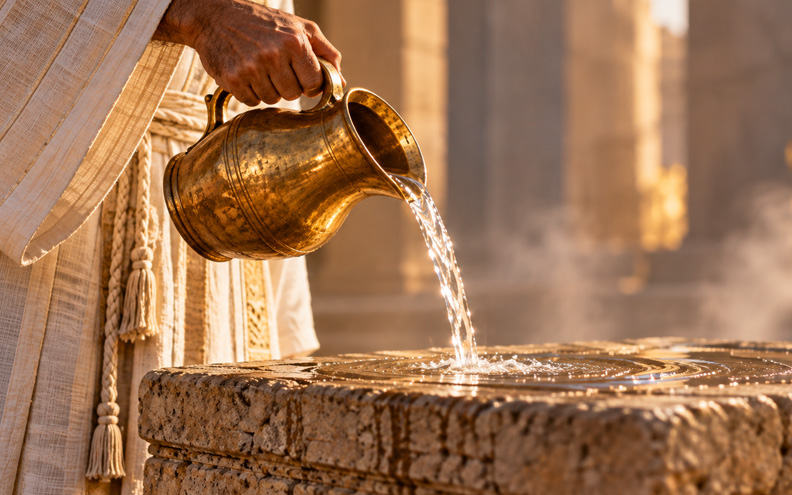
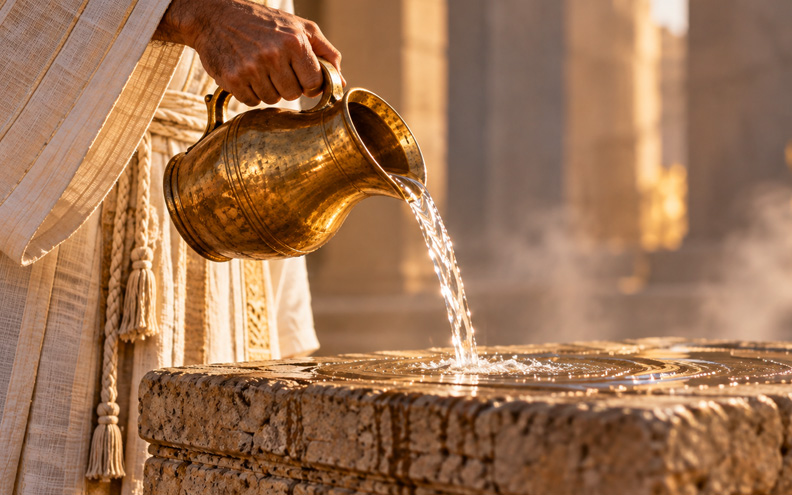
Water was drawn from the Pool of Siloam and carried to the Temple in a golden vessel. As the procession approached the Water Gate, trumpet blasts were sounded. The priest then ascended toward the altar, where the water libation was performed.
For the people of Israel, the symbolism was immediately understandable. Water was not merely part of a festive ritual. Rain determined the harvest and directly affected the lives of the people. Sukkot, falling at the close of the agricultural year and the beginning of the rainy season, was therefore naturally associated with the expectation of God’s provision and blessing.
Against this background, the words of the prophet Isaiah take on particular force:
“Therefore with joy shall ye draw water out of the wells of salvation” (Isaiah 12:3).
The prophet Zechariah also directly connects Sukkot with rain:
“And it shall be, that whoso will not come up of all the families of the earth unto Jerusalem to worship the King, the LORD of hosts, even upon them shall be no rain” (Zechariah 14:17).
And it is during this festival that Yeshua stands and cries out:
“If any man thirst, let him come unto me, and drink.”
His words become especially powerful when heard against the water imagery of Sukkot. The people knew the Temple ceremony of the water libation and the prophetic words about drawing water from the wells of salvation. Yeshua takes an image familiar to them and reveals a deeper meaning through it.
John leaves no doubt about what Yeshua was referring to:
“But this spake he of the Spirit, which they that believe on him should receive” (John 7:39).
Yeshua is speaking not merely about rain or physical thirst, but about the spiritual thirst of the human heart and the Holy Spirit whom those who believe in Him would receive.
The wider context of Isaiah 12 makes this connection even more striking. Before speaking about drawing water, the prophet declares:
“Behold, God is my salvation; I will trust, and not be afraid” (Isaiah 12:2),
and then continues:
“Therefore with joy shall ye draw water out of the wells of salvation” (Isaiah 12:3).
Now, in the midst of Sukkot, Yeshua invites the thirsty to come to Him.
This gives His words extraordinary depth. He is not simply using water as a beautiful metaphor. He is speaking during a festival filled with images of water, life, and God’s blessing, and He invites people to come to Him and receive “living water.”
Understanding the Jewish context allows us to hear Yeshua’s words more nearly as those standing in Jerusalem that day would have heard them.
Sukkot reminded Israel of water, without which life on earth cannot continue. Yeshua used that familiar image to speak of the Holy Spirit, who satisfies the spiritual thirst of the human heart.