
Heeding the Word of Grace
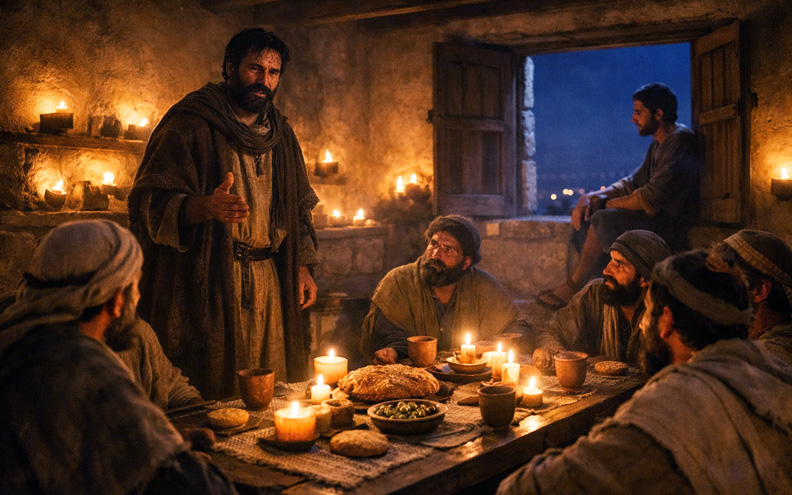
The account I wish to address is recorded in Acts 20:7-12. “And upon the first day of the week, when the disciples came together to break bread, Paul… continued his speech until midnight” (Acts 20:7). They had not gathered merely for a meeting or simply to “hear a sermon” – they had assembled for the breaking of bread, for the Lord’s Supper, to reaffirm their hearts in the Covenant.
There is vital spiritual precision in this: the breaking of bread was not an addendum to their gathering, something “for later.” It was the center around which the word, prayer, worship, and fellowship revolved. “For as often as ye eat this bread, and drink this cup, ye do shew the Lord’s death till he come” (1 Corinthians 11:26). The Supper returns us to the foundation – to what the Lord has accomplished, not to what we have managed or failed to manage.
Paul continued speaking until midnight, and I am certain he spoke of grace and truth. Again and again, he brought his listeners back to the grace of the Messiah – to that upon which faith rests. Knowing the law and religious life from within, he understood how easily the focus can shift imperceptibly: to begin trusting in ourselves, in “correctness,” in our own efforts. Therefore, entering into the theme of grace and truth, Paul went so deep he could not stop – because this truth sobers the heart and establishes it upon the only foundation, upon the Lord.
And here it is crucial to remember: the enemy knows how to work with the Word. He need not necessarily come with overt falsehood – sometimes a small distortion is sufficient for the poison to enter unnoticed. Therefore, we do not need to seek “special revelations” for the sake of impressions. We need to hold fast to the purity of the word of grace, because it is precisely this that restores sobriety and clarity to the heart.
Scripture then adds a detail that seems to illuminate the scene: there were many lamps in the upper room. Much light. Where the word of grace resounds, it becomes bright – not only in the mind, but within. And it is against this very backdrop of light that a young man named Eutychus appears, sitting in the window, at the very edge, in a liminal space.
He is seemingly among the light, among the disciples, among the word, yet simultaneously at the exit, at the boundary. And this condition is familiar to many: to be near spiritual life, to hear the right words, even to agree – and yet to keep one’s heart on the windowsill. The most perilous place is to be near the light but to live on the edge, in dividedness. There it is easy to lose attention, easy to miss the moment when sleep is already overtaking you.
Scripture speaks plainly: “And as Paul was long preaching… there sat in a window a certain young man named Eutychus, being fallen into a deep sleep… and fell down from the third loft, and was taken up dead” (Acts 20:9). And it is significant that the tragedy occurred not “somewhere in the world,” but where there is much light, where the word resounds, where the assembly gathers. This is a warning without condemnation: it is insufficient merely to be present – one must remain watchful in heart.
Paul’s response reveals the very heart of the Gospel. “And Paul went down, and fell on him, and embracing him said, Trouble not yourselves; for his life is in him” (Acts 20:10). He does not begin with reproaches. He does not transform the fall into a public lesson. He goes to the fallen one and embraces him. Grace does not finish off the fallen – grace raises them up.
This is a profoundly important spiritual principle for the community. When someone stumbles, falls, loses sobriety, our initial response reveals what we truly live by: law or grace. Scripture teaches: “Brethren, if a man be overtaken in a fault, ye which are spiritual, restore such an one in the spirit of meekness; considering thyself, lest thou also be tempted” (Galatians 6:1). Restore – yes, but in the spirit of meekness, not in the spirit of superiority.
And immediately it is added: “Bear ye one another’s burdens, and so fulfil the law of Christ” (Galatians 6:2). To bear burdens means not to push a person away in their moment of weakness, not to brand them, not to make their fall a convenient topic of conversation. It means to accept the responsibility of love – to offer one’s shoulder, to cover, to support, to help them return.
After this, Paul ascends again and continues. And Scripture notes: he broke bread. As if underscoring once more – the Covenant remains central. Not emotions, not the drama of the moment, not fear, but the Covenant, which sustains and gives life. The Supper reminds us: the foundation of salvation and restoration lies not in our flawlessness, but in the faithfulness of the Lord.
To avoid living on the windowsill, we need inner clarity – not merely knowledge, but an enlightened heart. Therefore, Paul’s prayer for believers is so vital: “That the God of our Lord Jesus Christ, the Father of glory, may give unto you the spirit of wisdom and revelation in the knowledge of him: The eyes of your understanding being enlightened” (Ephesians 1:17-18). When the eyes of the heart are enlightened, one hears the word differently, sees oneself differently, endures seasons of pressure and temptation differently.
And there is yet another warning that sounds exceedingly practical and sober: “Love not the world, neither the things that are in the world… For all that is in the world, the lust of the flesh, and the lust of the eyes, and the pride of life, is not of the Father, but is of the world” (1 John 2:15-16). The window is an image of what we admit through our eyes and ears. If the heart constantly gazes outward, if it feeds on that which leads away from God, sleep comes more swiftly than we acknowledge.
But the conclusion of this account is full of hope. The word continued until dawn. The lamps burned, and dawn arrived – and the young man was found alive. This is not merely a happy ending; this is God’s answer: even if someone has fallen asleep and fallen, the Lord is able to raise them up. And our part is not to close the way of return through harshness, but to open it through love and truth, so that the word of grace may once again become light to the person, not accusation.
Pastor Oren Lev Ari