
This Is Our Part – To Keep the Light Burning in Dark Times
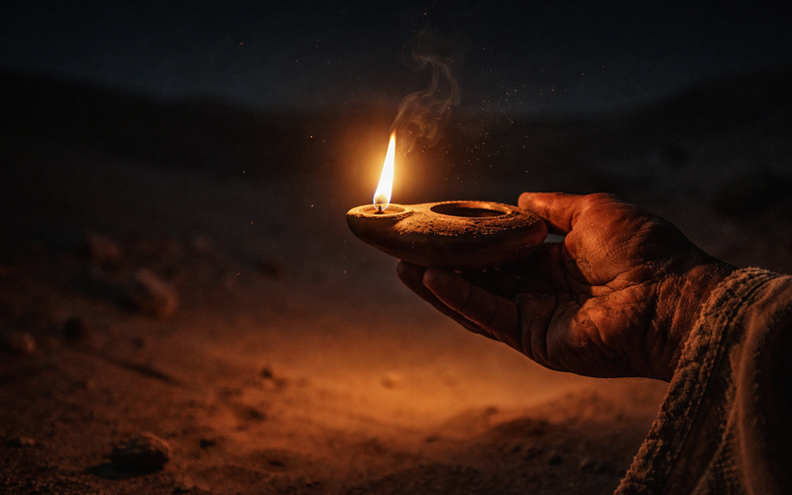
We often speak about what Christ has done for us – and rightly so. We speak of the finished sacrifice, of grace, of salvation, and of the gift of the Holy Spirit. Yet alongside this great truth, Scripture repeatedly reminds us of another side of the spiritual life – our responsibility. There is what God accomplishes by His power, and there is what He calls us to in obedience. God provides the source, but man must light the lamp.
In the book of Exodus we read: “And thou shalt command the children of Israel, that they bring thee pure oil olive beaten for the light, to cause the lamp to burn always” (Exodus 27:20). In these words we find an important spiritual principle. The Lord is not speaking of a passing surge, a brief moment of inspiration, or a mood that rises and fades. He is speaking of a light that must burn “always.” That is where true spiritual maturity is found – not merely in experiencing God’s touch once, but in keeping the fire alive along the way.
Very often, people want everything to happen without their participation. It can seem as though God should turn on the light Himself, fill us Himself, sustain us Himself, and do for us what belongs to our faithfulness. But the Lord has already done what is essential. In Christ, access to the Father has been opened to us, the Holy Spirit has been given, the way has been made, and life from above has been granted. Heaven is not shut. The source has not run dry. The wiring is already in place. But the switch, figuratively speaking, is on our side. What God has given must be received, guarded, and brought into action through faith and obedience.
The problem for many believers is not that they lack truth, but that they rely too heavily on feelings. Today a person feels uplifted and says he loves God, and tomorrow he feels inwardly empty and thinks everything has vanished. But spiritual life cannot be built on emotions alone. Feelings are changeable, while faithfulness is born not out of mood, but out of the decision to stand before God. Faith does not cancel emotion, but heals it and restores it to its proper place. When a person lives by faith, his inner life gradually begins to come into order.
That is why Scripture speaks of pure oil beaten from olives. It is an image not of accidental inspiration, but of something gained through nearness, constancy, and inward honesty. We cannot live on someone else’s oil. We cannot keep the light burning on the memory of yesterday’s visitation alone. Personal relationship with God cannot be replaced by the atmosphere of a gathering, a powerful sermon, or the momentum of those around us. All of these things matter, but they are not enough. The light is sustained where there is a living connection to the Source.
That Source has been opened to us in the Lord. Even if it seems to a person that he does not hear the voice of God, that does not mean dialogue is impossible. God already speaks through His Word. He opens the heart, instructs, convicts, comforts, and brings us back to the truth. A personal relationship with Him is not born from a special spiritual state, but from faithful abiding before Him. The one who comes to Scripture, to prayer, and to silence before God draws from that very oil without which the light quickly dies out.
That is why the words of Yeshua sound with such clarity: “Ye are the light of the world. A city that is set on an hill cannot be hid. Neither do men light a candle, and put it under a bushel, but on a candlestick; and it giveth light unto all that are in the house” (Matthew 5:14-15). Light is not given to a person for himself alone. It is needed in the home, in the family, in the congregation, in ministry, in the workplace, and in the ordinary circumstances of life. But if there is no oil within, there will be no light without. It is impossible to shine for others for long if you yourself do not remain in the presence of God.
The parable of the ten virgins reminds us of the same truth. Outwardly, they all appeared equally prepared to meet the bridegroom, but what proved decisive was the presence of oil. For there comes an hour when borrowed things are no longer enough – when you cannot quickly borrow someone else’s faith, someone else’s prayer life, or someone else’s closeness to God. “Watch therefore, for ye know neither the day nor the hour wherein the Son of man cometh” (Matthew 25:13). Spiritual readiness is not formed a minute before midnight. It is built through daily faithfulness, through those quiet decisions a person makes again and again.
There is another important truth here: the life of a believer is not meant to be an endless search for oneself in the dark corridors of the past, but a journey with God toward His light. The tabernacle in the wilderness was a place of meeting. It was not given so that a person might turn inward and remain shut up within himself, but so that he might learn to come into the presence of God. In this there is also an image of the life of the community. We are gathered not merely as people with similar views, but as a sanctuary in which God desires to dwell. Here we are not called to condemn and crush one another. We are called to uphold one another, to pray, to bear burdens, and to bring one another before the Lord in love.
Therefore spiritual maturity is shown not in harshness, not in a religious mask, and not in the habit of judging. It is revealed in the ability to remain in the light and to help others keep their light from going out. Christ does not stand for us before the Father in order to destroy us, but to save, cleanse, and lead us onward. If this is how He deals with us, then we too must learn to look at one another not through the eyes of accusation, but through the eyes of mercy and responsibility.
It is especially important to remember this in dark seasons of life. There are times when a person is weak, when life is hard, when he does not understand what is happening, when pain, fear, exhaustion, and outside pressure close in. But darkness is not always a sign of defeat. In biblical thinking, the day begins with evening. That means that even where it is still dark, God is already preparing the dawn. The darkest seasons of life are not necessarily the end – very often they are the beginning of what God is about to do next. That is why, in the dark, it is especially important not to forget to light the candle.
At times, victory does not look like a dramatic miracle, but like simple faithfulness. To rise in the morning and come to God again. To open the Scriptures when strong feelings are absent. To offer a word of prayer when the soul feels dry. Not to give up, not to grow hard, not to hide the heart, not to let darkness persuade you that there will be no more light. Fire drives away the beast, light exposes fear, and the presence of God restores a person’s inward steadiness. Where the lamp is burning, darkness no longer reigns completely.
That is why it is so important today to hear this call not as a rebuke, but as a return to what matters most. The Lord does not demand the impossible from us. He calls us to our part – to abide in Him, to gather oil, to keep the light, and to carry it onward. Christ has done what man could never do. Yet man is still told: bring the oil, light the lamp, and let it burn always. In this there is faithfulness, maturity, and true spiritual life. Our part is not to replace God’s work, but to answer it faithfully.
Pastor Oren lev Ari